
Book a Free Call
No commitment required
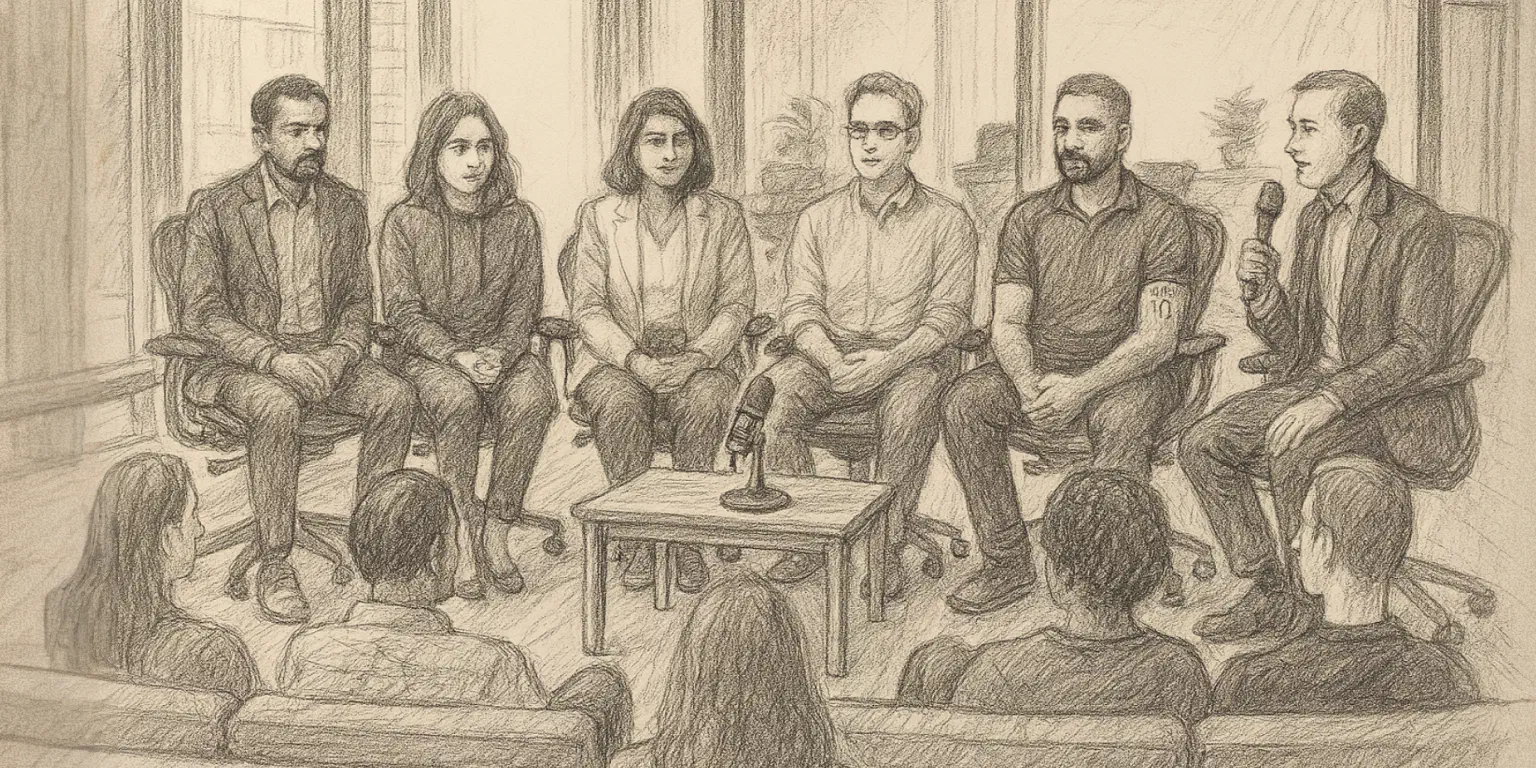
How does a team stay ahead of a technological revolution that redefines itself every few months? In a landscape filled with hype and fleeting trends, the most valuable asset is practical, hard-won knowledge. At Wawandco, we believe the best way to cultivate this knowledge is to intentionally create spaces where curiosity can flourish. We constantly facilitate these discussions around emerging technologies, not just to follow the conversation, but to lead it by discovering new applications that will directly benefit our clients.
Our recent internal panel with our five, peer-voted AI Champions was this philosophy in action. This wasn’t a top-down mandate; it was a grassroots gathering of passionate experts chosen by their peers. The goal was to create a living lab where we could share stories, debate limitations, and ultimately, sharpen the skills we bring to every client project. The insights that emerged were surprising, funny, and a powerful indicator of how we’re building the future.
The panel kicked off with a simple, practical question:
“How did AI save you time or lead to a better outcome this week?”
The answers immediately demonstrated how our internal mastery of these tools translates into tangible client benefits.
One champion from our operations team described a recent security project. The task was to create over 300 unique “typosquatted” domains—believable but fake URLs like “Netfl1x” or “Wawandcoo”—for a phishing simulation. Manually, this is a tedious, multi-hour slog prone to human error. Using a well-crafted AI prompt, the entire list was generated in just 10 minutes. That’s a direct translation of internal efficiency into robust security solutions for our clients, delivered faster.
A developer on the panel shared a two-fold approach. First, he uses AI as a tireless code reviewer.
“I can send a pull request with 30 changed files, and the AI acts like a senior developer looking over my shoulder, catching potential mistakes I might have missed.”
This use of AI as a development partner is increasingly validated in the tech industry, where such tools are used to automate code refactoring and enhance quality.
Second, he uses it as a learning accelerator. He’ll write a functional SQL query himself, then ask the AI:
“How can I make this better?”
The AI often refactors the code using more performant techniques he may not have known, turning a simple task into a valuable upskilling opportunity.
This theme continued—from a project lead who turned a daunting 4-hour research task on a futuristic app into a 15-minute executive brief, to our HR team using AI to analyze survey data for cultural patterns. This reflects a broader trend where major enterprises have seen developer efficiency increase by as much as 20% by integrating AI assistants.
Each story reinforced a core principle: when our team operates more efficiently and intelligently, our clients are the primary beneficiaries.
But our exploration goes far beyond simple efficiency. We encourage the kind of out-of-the-box thinking that leads to truly innovative solutions. The most unforgettable story of the day came from our design lead.
“I went to four dermatologists over two years for a persistent skin issue.”
She began. Frustrated and having spent significant money on treatments that didn’t work, she decided to try something radical.
“One day I just said, ‘Okay, I will use ChatGPT as my dermatologist.’”
She carefully explained her situation, detailed the treatments she’d already tried, and asked for advice. The AI suggested a simple, affordable hydrating routine using products from a local store. She tried it, hoping for the best.
The result?
“It went perfectly. I don’t have it anymore.”
She said with a smile.
The room erupted. This personal success story, while remarkable, isn’t just a fluke. It mirrors a broader trend validated by scientific research. Studies have demonstrated that modern AI models can achieve high diagnostic accuracy in dermatology, with one recent 2025 study showing an 89.3% accuracy rate across hundreds of real-world cases. In some studies focused on specific conditions like melanoma, AI has even been shown to outperform human dermatologists. These technologies are increasingly seen as valuable tools that support clinicians by enabling faster and more accurate identification of skin lesions.
This story, along with another about a champion using an AI voice tool to practice his English and get instant feedback, perfectly captures the spirit of creative problem-solving we cultivate. Even a seemingly silly anecdote about a team member who admits to having poor drawing skills, using one AI to generate a text prompt to feed into an image-generation AI, speaks volumes. It’s about using the tools at hand, no matter how unconventional, to overcome a personal limitation and achieve a goal.
This brought the conversation to its most critical point: where does our expertise end and the AI’s assistance begin? The consensus was that this isn’t a handoff, but a partnership. This aligns with the formal concept of “Human-in-the-Loop” (HITL), a collaborative approach where human expertise is integrated with AI systems to enhance accuracy, handle ambiguity, and provide crucial ethical oversight.
“I don’t think I draw the line. It’s just a walk along the way.”
One developer mused. It’s a continuous back-and-forth process. You provide the deep project context the AI lacks, review its output, write some code yourself, and then return to the AI for a check-in. It’s a dance, not a delegation. This oversight is critical, as research has found that up to 40% of AI-generated code can contain security vulnerabilities.
Another champion emphasized that the human’s role is to be the “thinking partner,” not just a prompter. This means pushing beyond simple questions and using AI to challenge assumptions and explore alternatives. This philosophy was perhaps best summed up by a poignant observation:
“Learning things by heart has acquired a higher value now. If you don’t have an external element to fact-check what you are getting from AI, you have to be that person.”
This is a vital point. Because AI systems generate content based on patterns rather than genuine understanding, they can “hallucinate” or fabricate information that sounds plausible but is incorrect. Research highlights the paradox of AI being both a powerful tool for fighting misinformation and a potential source of it, concluding that human-in-the-loop approaches are essential to guarantee accuracy and reliability.
So, why do we share these internal stories? Because this culture of continuous, hands-on learning is our core promise to our clients. When you partner with Wawandco, you’re not just hiring a team of skilled professionals; you’re gaining access to an entire ecosystem of innovation that is constantly vetting, testing, and mastering the next wave of technology.
The time we spend exploring AI’s potential to be a dermatologist or an art director is time spent honing the creative, agile problem-solving skills we apply to your most complex business challenges. The debates we have about AI’s limitations and ethical boundaries, like potential biases in diagnostic models against underrepresented skin tones, ensure that when we recommend a solution, it’s not based on hype, but on a deep, practical understanding of what works and what is responsible.
Think of these discussions as our live R&D sessions. They are how we transform a world of abstract possibilities into a curated set of powerful, reliable tools. Our internal curiosity is your competitive advantage, ensuring the solutions we build for you today are robust, innovative, and ready for the challenges of tomorrow.