
Book a Free Call
No commitment required
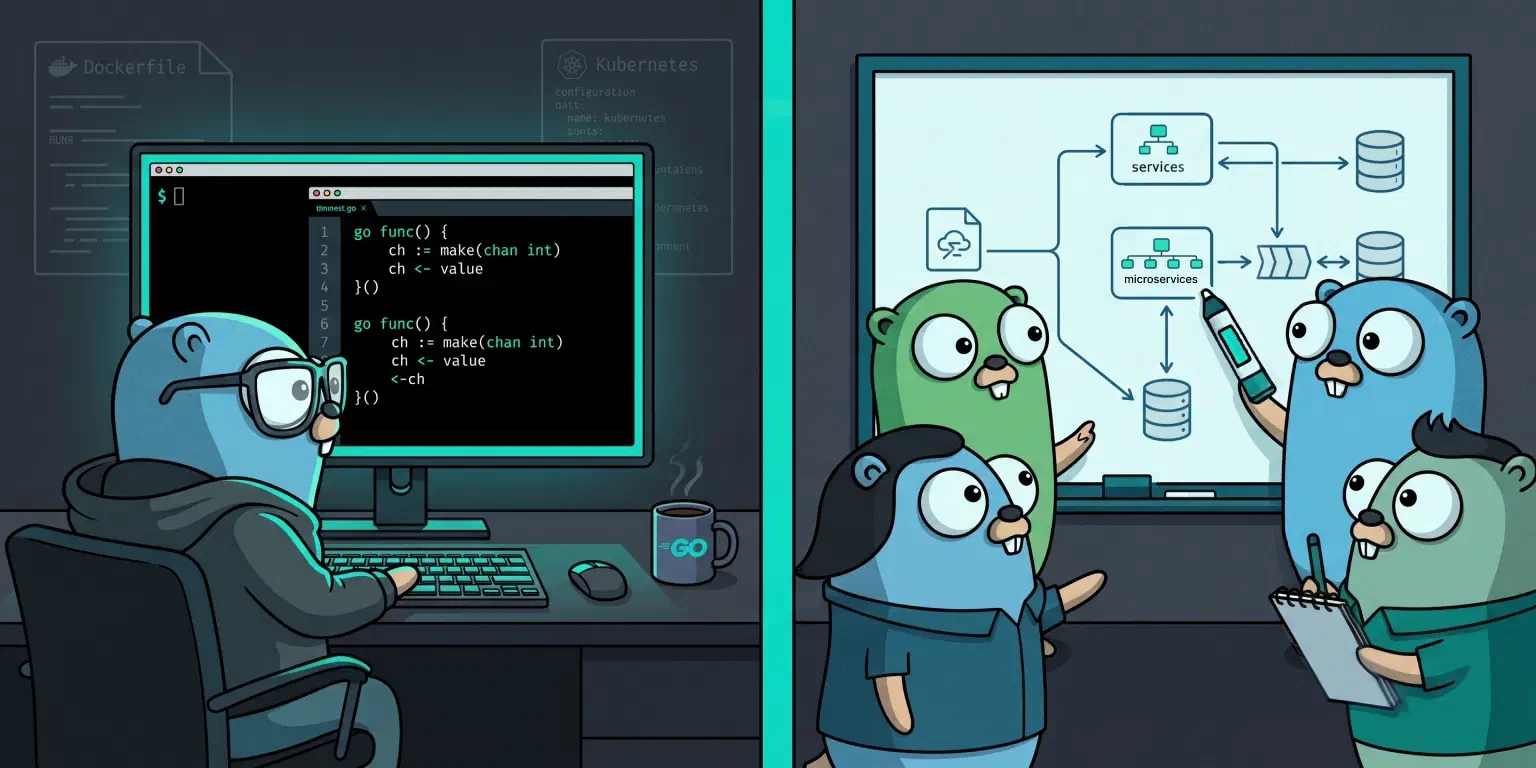
Docker. Kubernetes. Terraform. Prometheus. These are not side projects — they are the structural pillars of modern cloud infrastructure. And they are all written in Go.
If your engineering roadmap involves microservices, high-throughput APIs, or cloud-native architecture, you are already operating in Go’s territory, whether you’ve acknowledged that yet or not. The language wasn’t designed to be elegant — it was designed to be production-grade. And that distinction is exactly why finding the people who know it well has become one of the more quietly painful problems in engineering leadership.
According to SlashData’s 2024 developer report, there are approximately 4.7 million Go developers worldwide — a number that sounds substantial until you consider the demand side. Go ranked as the third fastest-growing language on GitHub’s Octoverse in 2024. Cloudflare Radar’s Year in Review shows Go now accounts for 20% of all API calls made by automated clients, up from 12% the previous year. Google, Uber, Dropbox, Netflix, and American Express have not placed experimental bets on it — they’ve built core systems on it.
That gap between supply and demand is where your hiring problem actually lives. Senior Go developers are scarce, command premium compensation, and are rarely passively looking. Choosing the wrong model for engaging that talent doesn’t just slow you down — it compounds. A bad hire or a bad vendor in Go will cost you significantly more than the invoice suggests.
This is why the conversation shouldn’t start with job descriptions or staffing vendors. It should start with understanding what you are actually buying.
Every form of external Go talent engagement falls into one of three categories. They are frequently confused — sometimes even by the vendors selling them.
Staff augmentation means bringing one or more Go developers into your existing team. They work under your management, inside your processes, using your tools. The vendor handles payroll and HR logistics. You handle everything else, including direction, architecture, and quality.
A dedicated team is a self-sufficient unit — developers, QA, and a delivery manager — assembled to work exclusively on your product. The vendor manages all operational overhead. You retain strategic control and product vision, but the day-to-day is theirs to run.
Project outsourcing means handing a defined scope to an external team and receiving a finished deliverable. You’re involved at the beginning — requirements — and at the end — acceptance. Everything in between is managed by someone else entirely.
A useful mental model: staff augmentation is hiring a sous-chef to work in your kitchen. A dedicated team is hiring a full kitchen crew that reports to you. Outsourcing is hiring a catering company — you describe the menu, they handle everything else.
The difference matters because each model allocates management burden, institutional knowledge, and execution risk very differently.
Staff augmentation makes the most sense when you already have a functioning engineering team with a defined architecture, and you need to fill a specific skill gap within a bounded timeline. Six months of Go expertise for a microservices migration, for example. A pair of senior engineers to accelerate an API layer before a release window.
The core characteristic of this model is that management responsibility stays with you. Augmented engineers join your Slack, attend your standups, and report to your engineering manager. What you get from the vendor is sourcing and employment logistics — not leadership.
That tradeoff has a real upside: speed. Reputable augmentation vendors can present pre-vetted Go candidates within days, bypassing the full recruitment cycle entirely. What you give up is resilience. Knowledge walks out when the engagement ends. There’s no built-in QA or project management layer.
Augmentation works when your scope is well-defined, your team is functional, and you need bandwidth — not expertise transfer.
The dedicated team model was built for something different: sustained product development over years, not quarters. If you’re building a SaaS backend, a fintech infrastructure layer, or any system that will evolve well past an initial launch, this is where augmentation starts to break down.
The compound benefit of dedicated teams is institutional knowledge. As a team builds your system over eighteen months, two years, three years, they accumulate context that makes every subsequent feature faster and better-informed. That’s not a soft benefit — it’s measurable in reduced onboarding time for new features, fewer regression errors, and better architectural decisions made by people who understand why your system is shaped the way it is.
The cost profile is also different. Industry benchmarks suggest a dedicated team of four to six Go developers, a QA engineer, and a delivery manager in Eastern Europe typically runs between $200,000 and $350,000 annually — compared to $500,000 or more for equivalent US-based in-house headcount. These are order-of-magnitude estimates, not quotes, but the direction is consistent: dedicated teams offer cost predictability that pure augmentation and outsourcing rarely match.
The tradeoff here is time. Dedicated teams take weeks, not days, to assemble and onboard. Cultural and timezone alignment requires real investment. And vendor selection becomes a high-stakes decision — you are trusting someone to build your core product.
A 4–6 hour timezone overlap with your core team is the operational baseline for this model to work well. Less than that, and you are operating asynchronously by necessity — which demands significantly more process maturity to execute effectively.
Project outsourcing hands execution entirely to an external team. You define scope and success criteria upfront; they plan, build, test, and deliver. Your involvement is intentionally minimal — and that is the point.
The model exists because not every organization needs to own the process — they just need the outcome. For companies without Go expertise in-house, or with no capacity to manage an engineering team, outsourcing trades visibility for velocity. For Go development specifically, it works well when the project has clear, stable requirements and a defined end state: a CLI tool, a data pipeline, a well-specified API integration.
What it doesn’t work well for is any product where requirements are still being discovered. Outsourcing has the highest risk of misalignment when scope is ambiguous — and scope creep in a fixed-price engagement doesn’t just slow you down, it creates the kind of adversarial dynamic that ends vendor relationships badly.
Before a single line of Go is written in an outsourced engagement, you need clear IP assignment clauses, NDAs, and data processing agreements appropriate to your regulatory environment. This is especially critical in fintech and health-tech contexts where liability follows the data, not the code.
Regardless of the model you choose, the quality of the Go talent determines outcomes. The language has specific idioms and philosophies that separate engineers who are fluent in Go from those writing Java with Go’s syntax — code that compiles and ships but misses the point entirely.
Any credible Go developer should be genuinely fluent in goroutines and channels — Go’s core concurrency primitives. Concurrency isn’t a feature in Go; it’s the language’s reason for being. A developer who can’t explain the difference between buffered and unbuffered channels, or when to prefer a mutex over a channel, isn’t production-ready for the systems Go is typically deployed into. The 2025 Go Developer Survey confirmed that employers consistently require hands-on production experience — not theoretical knowledge. Your screening process should involve code review of real-world repositories, not just algorithmic puzzles.
Beyond concurrency, look for practical experience with the standard library (net/http, encoding/json, context), sound error handling patterns, and interface-based design. Go has no inheritance. Good Go engineers think in composition.
A practical screening checklist: goroutines, channels, WaitGroups, select, and context cancellation; the Go module system (go.mod, go.sum); REST and gRPC API patterns; table-driven tests and race condition detection; Docker and Kubernetes familiarity; observability tooling like Prometheus and OpenTelemetry; and at least one common web framework — Gin, Echo, or Fiber.
For sourcing, Go talent concentrates in specific communities. The Gophers Slack, the Go Forum, and the GopherCon conference circuit are where senior engineers are actually reachable. GitHub is a sourcing tool — Go’s most active open source contributors are visible. For augmented or outsourced talent, strong talent density at competitive rates relative to US costs tends to concentrate in Eastern Europe (Poland, Romania), Latin America (Argentina, Colombia), and Southeast Asia (Vietnam).
The matrix below maps the dimensions that actually differentiate these models:
| Dimension | Staff Augmentation | Dedicated Team | Project Outsourcing |
|---|---|---|---|
| Project Duration | Short–Mid (3–12mo) | Long (12mo+) | Fixed / One-time |
| Scope Stability | Moderate | Flexible | Must be fixed |
| Management Capacity | You manage everything | Strategic only | Minimal required |
| Speed to Start | Fast (days) | Medium (weeks) | Slow (weeks–months) |
| Cost Predictability | Moderate | High (fixed monthly) | Variable (scope risk) |
| Knowledge Retention | Low | High | Low |
| Team Integration | Deep | Moderate | Minimal |
If you have an existing team and a defined problem, start with augmentation. It’s fast, controllable, and reversible. If you’re building a long-term product and want a partner that compounds value over time, invest in a dedicated team — the knowledge payoff is real and measurable. If you have a discrete, well-specified deliverable and want to hand off execution entirely, outsourcing is viable — but spend serious time on vendor selection and scope definition before you sign anything.
What to avoid at all costs: choosing a model based on what feels familiar rather than what fits your actual situation. The premium compensation Go commands, the global scarcity of senior talent, and the language’s consistently high developer satisfaction all point to the same reality — Go engineers have options. The hiring model you choose signals, before a single interview, whether you understand the market you’re operating in.
The best engagement isn’t the cheapest or the fastest. It’s the one where the incentives of your engineering partner align with the success of your product.
Wawandco Engineering Team — We’ve helped engineering leaders across fintech, SaaS, and cloud-native products find and structure the right Go talent for their stage of growth. Whether that’s augmenting an existing team or building one from scratch, we’ve seen firsthand what makes these engagements succeed — and what makes them fail.
Navigating the Go talent market? Book a discovery call with our team or follow our insights on LinkedIn.