
Book a Free Call
No commitment required
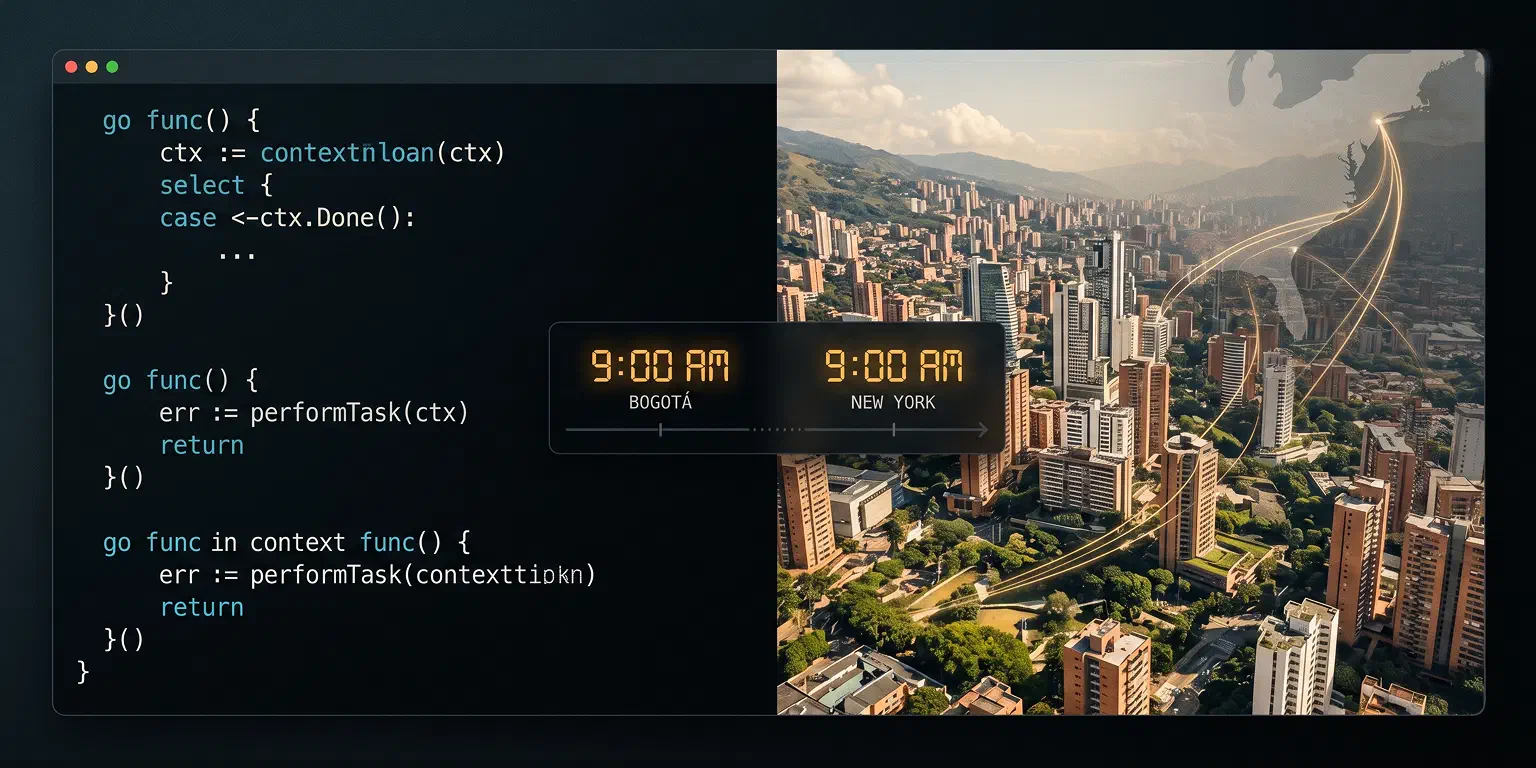
You’ve been through the pitch before. A recruiting firm or a dev shop offers you Go developers at a fraction of US rates, working out of Warsaw or Bangalore. The numbers look compelling on a spreadsheet. Then three months in, you know the feeling well: a critical question asked at 4 PM ET goes unanswered until the next morning. A production incident hits at 2 PM your time and 11:30 PM theirs. An architecture decision gets made over Slack, with half the context missing. The code ships, but it accumulates the kind of debt that only shows up when load spikes.
This isn’t an indictment of Eastern European or Indian engineering talent, which is genuinely strong. It’s an indictment of a model that treats timezone overlap as an administrative detail when it’s actually a core decision, one that compounds daily across every commit, every review, and every incident response.
At Wawandco, what we’ve learned is that proximity in time, not just proximity in price, is what makes a distributed team function like a team at all. That’s why we embed full-time engineers directly into our clients’ workflows rather than handing off deliverables from a distance. The overlap isn’t incidental. It’s structural, and it shows up in every standup, every code review, and every incident that gets caught before it becomes a postmortem.
The research on this is starker than most engineering managers realize. A peer-reviewed study by Prithwiraj Choudhury (Harvard), Tommy Pan Fang (Rice University), and Jasmina Chauvin (Georgetown) found that a single hour of time difference reduces synchronous communication by 11% between team members.[1] That’s not because of tools or processes. It’s a structural consequence of misaligned availability.
Scale that finding to an 8 to 12 hour gap, which is what you’re managing when your Go team is in India or Eastern Europe, and the compounding effect is severe. At 10 hours of separation, you’ve structurally eliminated most of the real-time communication that makes software teams effective. As nearshore outsourcing statistics reports, 90% of companies that switched from far-offshore to nearshore models reported better results, citing fewer delays, higher quality work, and smoother collaboration.[2] Nearshore engagements also show an 80% project success rate compared to roughly 60% for offshore projects.
The consequences aren’t just slower cycles. They’re subtler: assumptions harden into code before anyone questions them. A design conversation that would take twenty minutes on a live call becomes a 48-hour Slack thread, and by the time consensus arrives, two other decisions have already been built on top of the flawed one.
A survey of 80 software development customers confirms this pattern directly. Nearshore development consistently outperformed far-offshore across overall project success, quality, reduced project management effort, schedule adherence, and fewer communication problems.[3]
This is the context in which timezone stops being a scheduling footnote and becomes a technical decision.
Go was designed at Google to solve a specific class of problem: large-scale, concurrent backend systems that need to be fast, simple to deploy, and maintainable by teams that didn’t build them. That design philosophy has aged exceptionally well.
According to the Stack Overflow Developer Survey 2025, 17.4% of professional developers now use Go, reflecting its steady adoption for cloud infrastructure, backend services, and distributed systems.[4] Organizations such as Google, Datadog, Dropbox, HashiCorp, American Express, and Monzo rely on Go for microservices, high-throughput APIs, and DevOps tooling where performance and operational simplicity are essential.
The demand signal is clear, but supply hasn’t kept up. Senior Go developers in the US command salaries consistently above $135,000, with specialized roles climbing well past $180,000, and at those numbers, positions still go unfilled for weeks.[5] The hiring gap is real, and it widens every year as more engineering organizations adopt Go for critical infrastructure.
Go’s reputation for simplicity is both accurate and misleading. Its surface area is genuinely small, and a weekend is enough to read the spec. But that simplicity shifts the judgment burden entirely onto the engineer. The language does less hand-holding, not more.
This matters enormously in the context of distributed teams. Writing syntactically correct Go is straightforward. Writing Go that holds up under production concurrency, that fails gracefully, that a team inheriting the codebase two years later can reason about, is a different discipline. And it depends heavily on real-time communication.
Consider a few of the most common failure modes:
Goroutine leaks. Goroutines that never terminate consume memory forever, slowly degrading application performance until the system crashes. They’re particularly dangerous because they may work fine in testing but fail randomly in production under specific load conditions. This class of bug isn’t caught by the compiler. It requires reviewers who know what to look for, and the ability to have a quick conversation when something looks off. That conversation doesn’t happen well across a 10-hour gap.[6]
Concurrency assumptions that survive code review but not production load. Most production concurrency bugs in Go come not from complex patterns but from a small set of wrong assumptions about how goroutines actually interact. Catching these requires reviewers with production Go experience who can spot the problem in a pull request, not 18 hours later in an async comment thread.[7]
Error propagation in concurrent paths. Go’s explicit error returns are a deliberate design choice that forces engineers to reason about failure at every step. But in concurrent code, missed error handling in a goroutine doesn’t raise an exception. It silently fails, often taking data consistency with it. This is the kind of issue that gets caught in a live review, not in a comment.
None of these are exotic edge cases. They’re the daily reality of Go services running under real load. The only reliable defense against them is a combination of deep Go experience and a review culture where conversation happens fast, which means the team has to actually be awake at the same time.
The default argument for nearshore development starts and ends with cost savings. We want to get to the cost picture because it’s real, but it’s the wrong place to start.
Colombia’s most meaningful advantage for US engineering teams isn’t price. It’s that Colombian Time runs just one hour behind US Eastern Time. That means your daily standup happens at 9 AM with engineers who are alert and prepared, not people dragging themselves to a screen at midnight. Architecture conversations happen when both sides are fresh enough to actually disagree productively. Production incidents get a live response. Edge cases get caught in a real conversation instead of an async thread that takes two days to resolve.
The cost picture is meaningful. Colombian senior developers earn around 2.7 times less than their US counterparts, with salaries in the $54,000 to $69,600 range annually.[7] Against US Go salaries, that delta matters. But cost efficiency only pays off when quality holds, and quality compounds fastest when the team is working in the same window of time.
The talent pipeline backs this up. Colombia’s tech talent pool now exceeds 150,000 IT professionals across key hubs including Medellín, Bogotá, Barranquilla, Cali, and Cartagena. The country produces between 20,000 and 30,000 STEM graduates annually, with a significant share specializing in software engineering, data science, and AI, supported by top institutions like Universidad de los Andes and Universidad Nacional de Colombia.[9]
Colombia ranked second in South America on the StartupBlink Global Startup Ecosystem Index 2025, with 22.3% year-over-year growth. Bogotá alone has produced over 215,000 software and tech graduates in the last five years. These aren’t generalist developers cycling through bootcamps. The ecosystem is producing engineers with cloud-native and backend specialization, shaped in part by the presence of global firms like Amazon, Microsoft, Uber, and SAP that have established operations across the country’s main tech hubs.[10]
Colombia isn’t the only option in Latin America, and it’s worth being clear about why it stands out. Argentina produces strong engineers, but currency volatility and economic uncertainty add real risk to long-term team planning. Brazil has the largest talent pool in the region, but senior salaries there have been rising steadily and now sit closer to US market rates than most buyers expect. Mexico offers genuine timezone proximity for West Coast teams, though English fluency rates and infrastructure maturity vary significantly by city and talent tier. Colombia’s advantage isn’t that the others are weak. It’s that the combination of timezone alignment with the US East Coast, a maturing backend and cloud-native talent pool, and stable operating conditions is harder to find elsewhere in the region.
The best way to understand what timezone alignment actually buys you is to hear it from the people who tried the alternative first.
One of our US clients put it plainly after months of coordinating with an offshore team: “We’re really focusing on improving work-life balance. Navigating the extreme time zone differences has become unsustainable for our personal lives.” Another told us: “Just trying to get the engineering team on the same call takes a lot of calendar gymnastics.”
These aren’t complaints about code quality. They’re complaints about the structural cost of a model that asks people to absorb timezone friction as a personal burden, through early mornings, late nights, and the low-grade exhaustion of never quite being in sync with the people building your product.
Working with a Go team in the same timezone removes that burden entirely, and it changes the texture of collaboration in ways that are hard to fully appreciate until you’ve experienced the alternative.
When one of our US clients noticed their system was sending duplicate welcome emails to new users, we were on a call with their team within minutes. Not the next morning. Not after a round of async messages trying to establish whether the issue was urgent. Within minutes, during their business day, with the engineers who had written the relevant code and knew exactly where to look. That’s not a coincidence. These were the same engineers who had been embedded with this client for months, building the service and living with its decisions. They knew the codebase the way you know a room you’ve worked in for a long time. The issue was diagnosed and resolved before it could compound further, sparing their users from a confusing onboarding experience and their support team from a flood of tickets. That response time isn’t a function of effort or goodwill. It’s a function of being awake at the same time, and knowing the code well enough to act when it counts.
Architecture reviews work the same way. When a design decision needs a real conversation, both sides are in the same working hours, so edge cases get caught before they become incidents. Code ownership is taken seriously because engineers write code they know they’ll be asked to defend and extend on a live call. Daily standups happen at 9 AM ET with the engineers who wrote yesterday’s code and will write tomorrow’s, not via a recording or an async summary from the night before.
We treat code as a long-term asset, which means every service we ship comes with tests and documentation that the next engineer can actually use. Not the next Wawandco engineer specifically. Any engineer, including the client’s own team, who inherits the codebase six months from now and needs to understand why something was built the way it was. Craftsmanship, to us, isn’t an aspiration. It’s an operating standard, and it shows up in the things the shipping velocity number doesn’t capture.
This is what Go development as a craft actually looks like. The language rewards engineers who think carefully about what happens not when things work, but when they partially fail: when load spikes, when a dependency goes down, when a goroutine leaks under conditions that only appear in production. That kind of thinking is hard to evaluate from a resume and harder still to do justice to in async code review at midnight.
The timezone is free. The expertise isn’t. But together, they’re what make nearshore Go development worth the conversation.
Choudhury, P., Pan Fang, T., & Chauvin, J. (2024). Working Around the Clock: Temporal Distance, Intrafirm Communication, and Time Shifting of the Employee Workday. https://papers.ssrn.com/sol3/papers.cfm?abstract_id=3710778
Nearshore Outsourcing Statistics 2025. https://scaleupally.io/blog/nearshore-outsourcing-statistics/
Looi, M. & Szepan, M. Outsourcing in Global Software Development: Effects of Temporal Location and Methodologies. https://arxiv.org/pdf/2602.08084
Stack Overflow Developer Survey 2025 — Technology. https://survey.stackoverflow.co/2025/technology#most-popular-technologies
Golang developer job market analysis 2025. https://www.signifytechnology.com/news/golang-developer-job-market-analysis-what-the-rest-of-2025-looks-like/
Cox-Buday,K. (2017). Concurrency in Go: Tools and Techniques for Developers. O’Reilly.
Uber Go Style Guide. https://github.com/uber-go/guide/blob/master/style.md
Software Development in Colombia 2025 — Alcor BPO. https://alcor-bpo.com/software-development-colombia/
How to Hire Colombian Developers in 2025 — ScrumLaunch. https://www.scrumlaunch.com/blog/how-to-hire-colombian-developers-in-2025
Latin American Tech Talent: 6 Countries to Consider — Athyna. https://www.athyna.com/blog/top-latin-american-countries-for-tech-talent
Wawandco Engineering Team — We’ve helped engineering leaders across fintech, SaaS, and cloud-native products find and structure the right Go talent for their stage of growth. Whether that’s augmenting an existing team or building one from scratch, we’ve seen firsthand what makes these engagements succeed — and what makes them fail.
Navigating the Go talent market? Book a discovery call with our team or follow our insights on LinkedIn.