
Book a Free Call
No commitment required

Mobile releases face two fundamental challenges that traditional web deployments do not: the mandatory app store review process and user-driven adoption. These unique constraints make achieving both speed and stability—a hallmark of high-performing organizations as highlighted by Forsgren, Humble, and Kim in Accelerate—particularly difficult. These constraints create an unavoidable “Deployment Gap”—a time lag during which critical fixes cannot reach the entire user base instantly. This gap renders traditional hotfixes ineffective for client-side issues, leading to prolonged user frustration, negative reviews, and service degradation whenever a buggy binary is released. However, this article presents actionable strategies—Phased Rollouts, Feature Flags, and Monitoring—to overcome this challenge by prioritizing controlled deployment and remote mitigation.
To understand how to overcome the Deployment Gap, we must first analyze the standard mobile release process and its two core constraints.
Unlike web applications, where code resides on a server under direct control, a native mobile application is a single, self-contained binary file downloaded and installed locally. While the official app stores (Apple App Store for iOS and Google Play Store for Android) offer the safest distribution path, this model imposes two sequential, non-negotiable constraints on every release: the formal review process (Gatekeeper) and user-driven adoption. These two factors create an inevitable time lag and an adoption curve that severely limits our ability to respond instantly, demanding that all recovery efforts be planned for through proactive risk mitigation.
Every new version must pass through a Gatekeeper (Apple’s App Store or Google Play review process). This formal review is a crucial quality assurance step that establishes user trust and protects the platform’s integrity. However, it introduces a substantial time constraint that must be factored into every release timeline: while iOS reviews often take 24+ hours, Android submissions, despite an automated component, can occasionally be flagged for manual review, extending the wait to potentially seven days. We view this mandatory queue not as an obstacle, but as a critical, non-negotiable quality checkpoint that requires advanced foresight and meticulous planning to avoid bottlenecks.
Once approved by the Gatekeeper, the update timeline shifts entirely to the user. Users control when they manually initiate the download, and even automatic updates are staggered and dependent on device settings and connectivity. This phenomenon creates an inevitable adoption lag, meaning that for days or even weeks after a release, large segments of our user base will run different versions of the app simultaneously. This introduces significant complexity in diagnosing and solving bugs, as the fix isn’t uniformly available to the entire audience.
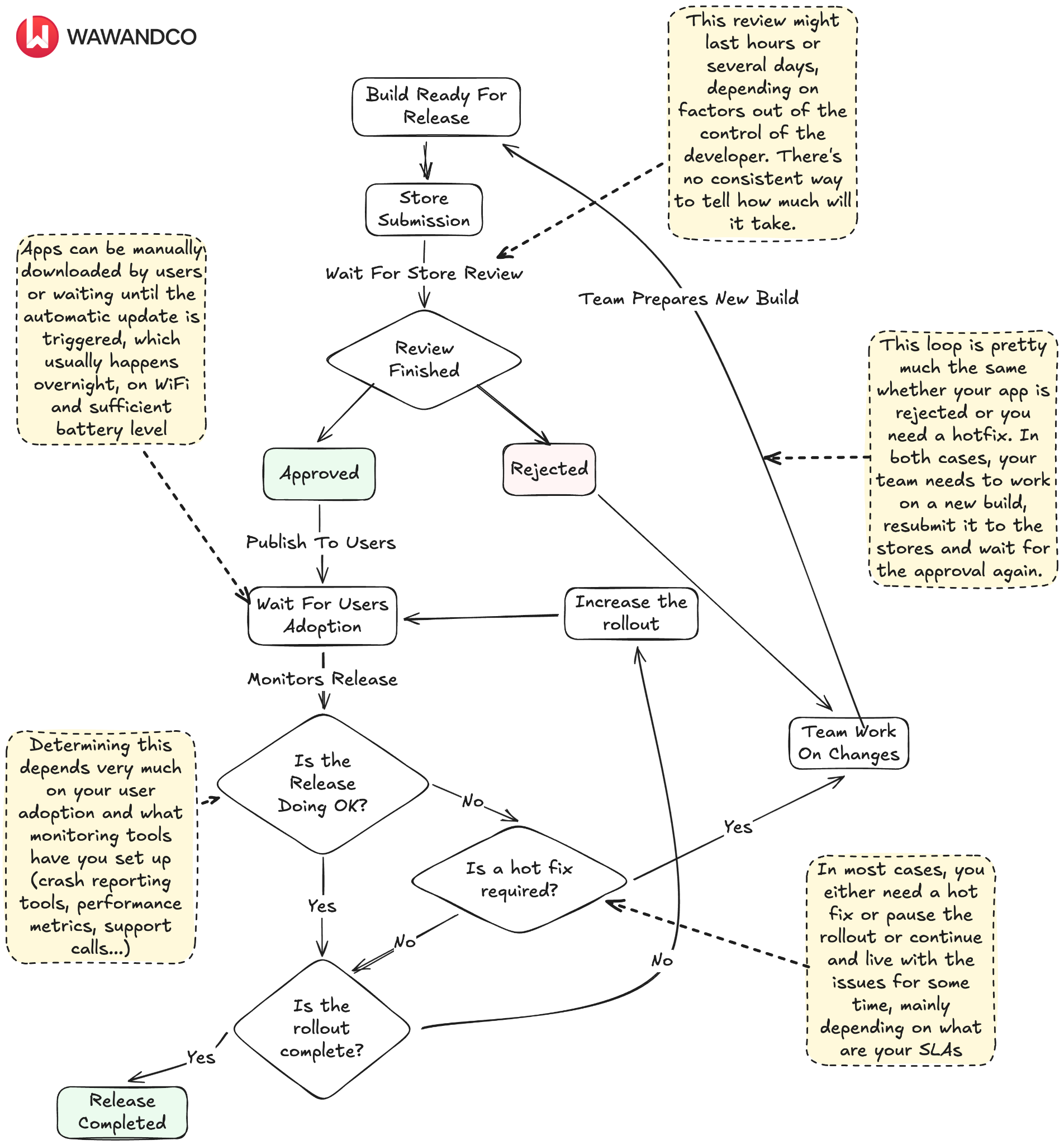
The combination of the Gatekeeper model and User-Driven Adoption forces the question: how do we bridge the resulting deployment gap?
The time gap between successfully pushing a new feature or a critical fix and its widespread user adoption is the core pain point of mobile engineering, presenting unique challenges extensively discussed in G. Orosz’s Building Mobile Apps at Scale: 39 Engineering Challenges. For any release—from a minor patch to a large new feature—the combined delay from the review queue and the adoption curve creates a prolonged period of ambiguity and risk.
If a new feature performs poorly, is confusing, or contains an overlooked issue, the resulting fallout is immediate: customer frustration, public reviews drop, service degradation, and help desk congestion spike. This deployment gap means that the time-to-correction for any release is delayed by the same hours or days that hinder an emergency hotfix. Furthermore, a frustrating scenario arises when a server-side fix is deployed but still requires a corresponding client-side dependency change; this forces developers back into the slow app store submission and review process, preventing instant recovery or value delivery.
While it is impossible to completely eliminate deployment gaps, we must be able to control our response to catastrophic production issues and act quickly. This requires clearly defined hotfix and rollback procedures.
A hotfix is a high-priority corrective release, limited strictly to essential changes, and reserved for catastrophic or blocking issues—situations where the immediate risk to the business (e.g., payment failures, widespread app crashes) outweighs the risks associated with an out-of-cycle deployment.
A hotfix is a minimal corrective release containing only essential fixes, reserved for severe production failures where the immediate business risk exceeds the risks of deployment.
— Adapted from Pressman, R. S., & Maxim, B. R., Software Engineering: A Practitioner’s Approach, 8th ed., 2014.
A hotfix requires submitting a new binary for review. On iOS, an Expedited Review may significantly reduce review time for genuinely critical issues, though approval is granted solely at Apple’s discretion. On Android, reviews are often faster due to higher levels of automation, but their unpredictability remains a persistent risk during emergency situations.
Rollbacks must be treated as planned and documented procedures. Unstructured rollback attempts in mobile app releases can cause extended outages, inconsistent app states, or user-facing errors, particularly under the pressure of urgent production issues. Formal rollback procedures—such as republishing a stable version or restoring a previous build—help reduce recovery time and minimize user impact.
On iOS, a rollback requires the re-submission of a previously stable build for full review, which introduces additional delay. On Android, a faster option exists: the problematic release can be immediately unpublished, and a prior stable version promoted back to the production track.
Beyond fixes, strategic delivery methods are required to minimize the adoption lag and ensure users receive stable versions quickly.
Delivery strategy relies heavily on understanding and utilizing platform mechanics to bypass the adoption lag. Both platforms rely on a combination of automatic updates (usually overnight on Wi-Fi) and manual user actions. Crucially, Android provides the powerful In-App Update API, which allows the application to directly prompt users to update while they are actively using the app. This mechanism can drive significantly faster adoption rates. Conversely, iOS lacks this native API, meaning a similar effect must be achieved through custom development—a version check integrated into the app that queries a backend endpoint to recommend or enforce an update. While not ideal, this custom solution is essential for driving critical adoption.
To effectively navigate the Deployment Gap and the inherent complexities of mobile releases, a multi-faceted approach leveraging several proactive strategies is essential. These strategies empower development teams to maintain stability, mitigate risks, and drive user adoption more efficiently. The following sections detail these critical approaches:
This is the final safety layer where bugs are caught by real users in a controlled environment.
Using tools like Crashlytics and analytics is essential to instantly validate the stability and health of every new binary.
This is the primary defense against catastrophic failure. By releasing incrementally (e.g., 1%, 5%, 10%), you can pause deployment if issues spike.
Feature flags wrap risky new code in remote toggles managed from a server, a practice championed in Working Backwards by Bryar and Carr.
This system uses alerts to inform users of issues or enforce a minimum required version.
Mastering the mobile release process is an opportunity to showcase engineering excellence and strategic foresight. By accepting and planning around the necessary constraints of the Gatekeeper model and platform versioning, we focus our energy on building sophisticated, proactive defenses: Monitoring, Feature Flags, and Phased Rollouts. This strategic approach ensures that we can quickly define the impact of any issue and execute a measured, controlled response rather than panicking.
As illustrated throughout this guide, practices like planned Hotfixes and documented Rollbacks are examples of these foundational strategies in action. Teams that implement such measures consistently achieve faster recovery, maintain system stability, and minimize user impact. By proactively adopting these approaches, mobile development teams can navigate the Deployment Gap, deliver superior user experiences, and continuously drive value.