
Book a Free Call
No commitment required
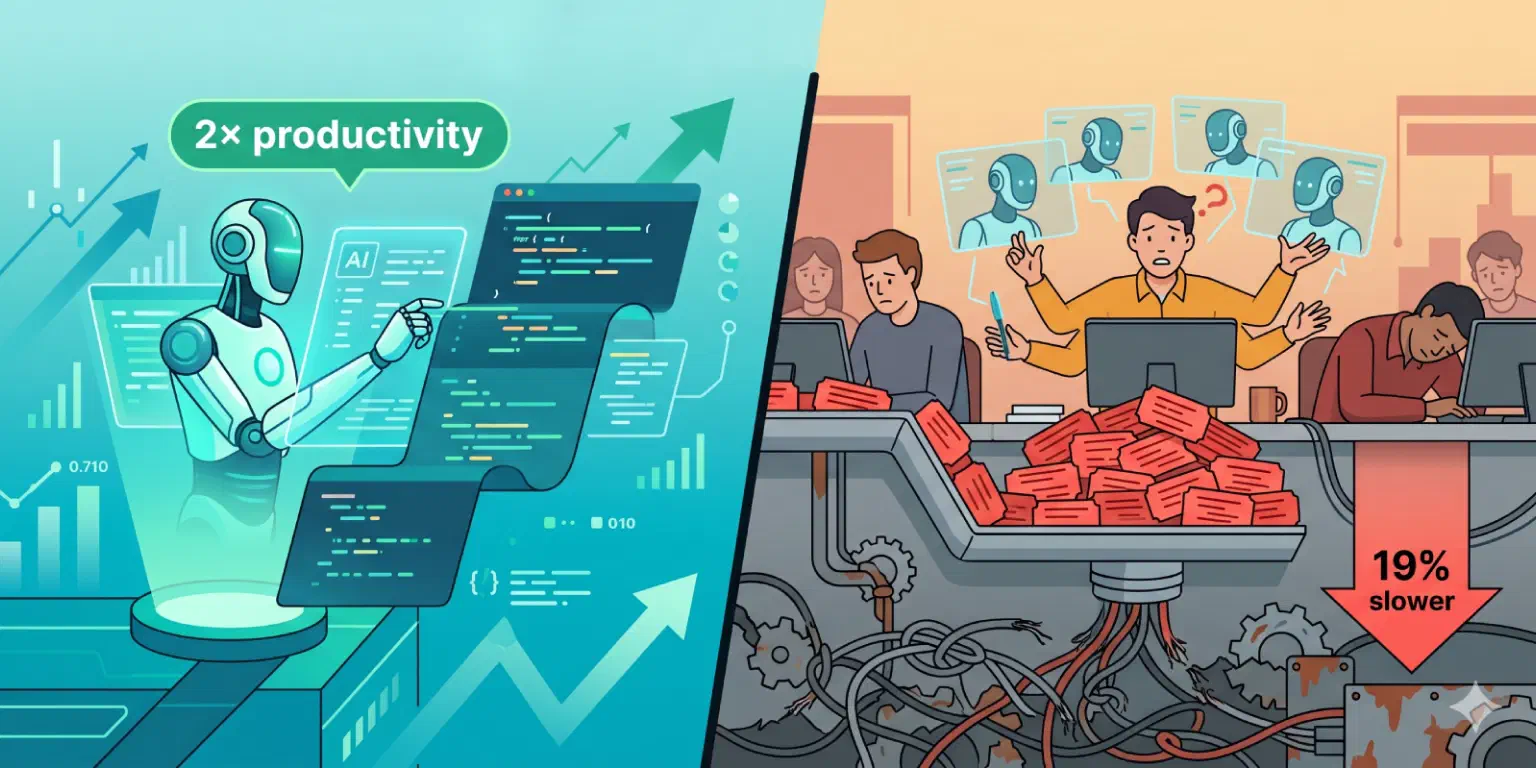
TL;DR: AI coding tools make individual developers faster, but engineering teams are shipping 19% slower. The 2025 DORA report and data from 10,000+ developers reveal why: review queues swell, technical debt compounds faster than paydown, and the shift from coding to orchestration creates a new bottleneck. The fix is not banning AI — it is redesigning team architecture around it.
Last quarter, a Series B SaaS company we work with noticed something strange. Their developers — equipped with the latest AI coding assistants — were committing 3x more code than the quarter before. PR velocity looked healthy. Standups were full of “AI generated the boilerplate, I just reviewed it.”
Yet their primary product release slipped by six weeks. The CTO called us, puzzled. The dashboard showed green. The roadmap was red.
This is the AI velocity paradox, and it is becoming the defining operational challenge of 2026. Individual speed is up. Team delivery is down. Understanding why requires looking past the commit graph and into the architecture of how work flows through an engineering organization.
The numbers are unambiguous. The 2025 DORA report found developers perceive a 20% speed increase with AI coding assistants, but teams deliver 19% slower once downstream friction is included. Faros AI analyzed over 10,000 developers and found heavy AI users create 98% more pull requests per person, yet PR review times ballooned 91%. GitClear studied 211 million lines of code and found code churn rose from 3.1% in 2020 to 5.7% in 2024, tracking directly with AI adoption.
At first glance, these numbers seem contradictory. More code. More PRs. Slower delivery. But the contradiction dissolves when you trace what happens to a line of AI-generated code after it is written.
AI coding does not just make developers faster. It changes the shape of the work flowing through your system. That change creates three specific bottlenecks that traditional engineering metrics miss entirely.
In a pre-AI workflow, a senior engineer might write 250 lines of original code per day. The reviewer — often the same engineer’s teammate — understands the context, watched the feature evolve, and can validate intent quickly. Review takes 15–30 minutes.
In an AI-assisted workflow, that same engineer submits 700 lines of mixed human and generated code. The reviewer faces a different problem entirely. They must:
The result is not just longer reviews. It is a queue. When every engineer is submitting 3x the volume, and every review takes 2x the time, the review queue becomes the dominant bottleneck in your delivery pipeline. One mid-market company we spoke with saw their average PR age rise from 1.2 days to 4.7 days after rolling out AI assistants company-wide.
AI-generated code has a specific quality profile. It is syntactically correct, often well-structured, and typically passes existing tests. But it is also conservative in the wrong ways — it repeats patterns from training data, misses domain-specific edge cases, and optimizes for immediate compilation over long-term maintainability.
GitClear’s analysis shows the result: code churn rising steadily with AI adoption. Generated code is often good enough to ship but not good enough to live with. The problem compounds because the next AI-assisted feature is already in flight. Refactoring never gets prioritized. Debt accumulates invisibly until a critical incident — a performance regression, a security flaw, a silent data corruption — forces a costly rewrite.
The 2025 DORA report found teams with high AI adoption experienced a 9% increase in bug rates. Princeton researchers found that reliability improvements occurred at half the rate of average accuracy improvements. The speed is real. The debt is realer.
Anthropic’s 2026 Agentic Coding Trends Report describes engineering roles evolving through three stages:
| Stage | Era | Developer Role |
|---|---|---|
| Coder | 2023–2024 | Writes code, AI suggests completions |
| Conductor | 2025–2026 | Defines tasks, AI executes, human reviews and iterates |
| Orchestrator | 2027+ | Designs architecture and agent workflows, multiple agents execute in parallel |
Most teams are in the Conductor phase today. Developers spend less time writing foundational code and more time prompting, reviewing, and correcting AI output. That is skilled labor — it requires architectural judgment, domain expertise, and the ability to spot subtle errors. But it is labor that does not scale linearly with team size.
When you hire a senior engineer in 2026, you are not just buying their typing speed. You are buying their judgment. And judgment is a finite resource. If your senior engineers are spending 60% of their time reviewing AI-generated PRs instead of designing systems, you have traded one bottleneck for another.
Here is the most insidious part: your engineering analytics platform probably cannot see the problem. Most tools track metadata — PR cycle time, commit volume, story points completed. They cannot distinguish AI-generated code from human-written code. A team shipping 5x more PRs looks healthier on a dashboard while silently accumulating correctness errors at 1.75x the normal rate.
The teams solving this are moving from adoption metrics to code-level measurement. They track:
Without this baseline, you are optimizing for speed you cannot afford.
The fix is not to ban AI. The fix is to redesign your team architecture around it. Here is what we have seen work in practice.
Speed up reviews by changing how work enters the queue. Smaller, well-scoped changes — even if generated by AI — review faster than sprawling feature PRs. We recommend:
The goal is not less review. It is faster review with higher signal-to-noise ratio.
AI excels at boilerplate, scaffolding, and routine refactoring. It does not excel at architectural decisions, edge-case reasoning, or understanding the business context behind a feature. The engineers who matter most in an AI-assisted world are not the fastest typists. They are the ones who can validate whether the generated solution is the right solution.
Protect their time aggressively. Remove meetings that do not require architectural judgment. Let senior engineers own the guardrails: coding standards, review checklists, and architectural decision records. Their judgment is your scarcest resource. Treat it that way.
Track what happens to AI-assisted code over time. Compare incident rates, rework patterns, and maintenance burden between AI-generated and human-written commits. If your AI-assisted code shows an 18% productivity lift but rework rates climb 25%, you know exactly where to intervene.
One company we work with implemented a simple rule: every AI-generated PR touching core business logic gets a 30-day follow-up tag. After 30 days, the team reviews whether that code required patches, refactors, or incident response. The data transformed how they use AI — they now reserve generated code for scaffolding and tests, not for domain logic.
AI agents are powerful, but they are not colleagues. They do not share context across sprints, mentor junior developers, or debate trade-offs in standup. They do not understand why your last migration failed, or why your biggest customer has a weird data shape, or why that one microservice must never be touched on Fridays.
The teams thriving in 2026 treat AI as an accelerant for already-cohesive engineering units — not as a substitute for hiring the senior judgment that keeps systems stable. AI can help a great team ship faster. It cannot turn a fragmented team into a great one.
There is a deeper pattern here. Every wave of developer productivity tools — from IDEs to CI/CD to cloud infrastructure — has followed the same arc. First, individual speed improves. Then, the organizational drag becomes visible. Then, teams redesign their processes around the new capability. The teams that win are not the ones that adopt fastest. They are the ones that adapt their architecture fastest.
AI coding is no different. The raw capability is here. The integration is not. The teams that solve the operational problems — review queues, quality measurement, human bottlenecking — will define the next phase of software development.
AI has changed how code is written. It has not changed what shipping reliable software requires: clear architecture, rigorous review, and experienced engineers who can tell the difference between a working demo and a production-grade solution.
If your roadmap is growing faster than your team can deliver, the answer is rarely more tools. It is usually more capacity with the right people — engineers who integrate into your workflow, understand your stack, and know when to say no to generated code that will haunt you next quarter.
At Wawandco, we have spent twelve years helping SaaS companies scale engineering capacity without sacrificing quality. We have seen every productivity trend come and go. The ones that stick are the ones built on top of teams that actually ship.