Book a Free Call
No commitment required
Symbol Security LLC
11-50 employees
Cybersecurity, Technology
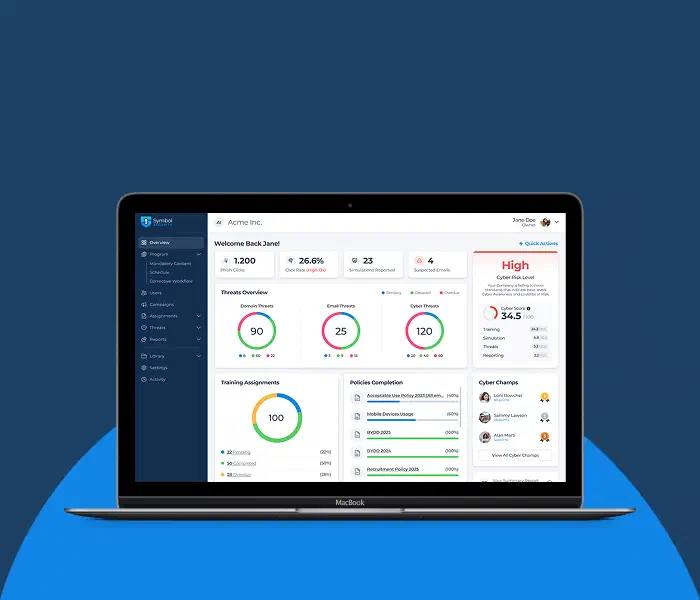
Phishing is one of those invisible threats most people think they’re too smart to fall for—until they do. For companies, a single click can spiral into a costly security breach. Symbol Security set out to tackle this challenge head-on, giving organizations a way to simulate real phishing attempts and train their teams before the damage is done. But like any new product in the cybersecurity space, their biggest challenge wasn’t just technology—it was trust. Symbol Security needed more than a good idea—they needed a platform and a website that would instantly inspire confidence. That’s where we came in.
As a brand-new project, Symbol Security needed everything: a professional website, a user-friendly platform, and a strong visual identity that reflected credibility. We knew the design would play a central role in gaining user trust and showing that this was a mature, reliable solution despite being new to the market.
Before putting pen to paper, we spent time deeply understanding Symbol Security’s vision. We started with conversations to understand the founders’ vision, the administrators who’d be running training programs, and the employees who’d be on the receiving end of phishing simulations. With those insights in hand, we began sketching ideas, keeping them intentionally low-fidelity at first. This allowed us to quickly explore different directions until we found the one that matched the company’s identity and ambitions.
Phishing simulations and training involve complex workflows, but we didn’t want users to feel overwhelmed. Our design approach broke big tasks into smaller, manageable steps, each presented on its own screen. We focused on clarity—clear actions, structured page hierarchy, and intuitive forms—so administrators could run even the most advanced simulations with confidence. Consistency was equally important: a unified design language across the platform meant that no matter where users landed, they felt guided and supported.
Behind the scenes, we built on Go with the Buffalo framework and PostgreSQL for reliable performance, supported by tools like Swagger for API documentation and RobotALP for automation. The frontend combined JavaScript, StimulusJS, HTMX, Hyperscript, and Webpack, enhanced by TailwindCSS, PostCSS, Bootstrap, and jQuery. We integrated specialized libraries such as Chart.js for analytics, TinyMCE for content editing, Flatpickr for date selection, and tools like Select2, Choices.js, and Bootbox to simplify input and modals.
For quality and reliability, we used Jest, Golangci-Lint, and the Microsoft SDK, while Yarn managed dependencies. Deployment and monitoring were handled through Docker, GCP, and BetterStack. On the product side, Figma and Linear helped us iterate quickly, while Airtable and Retool supported data operations and internal tooling. The result was a platform that balanced the sophistication of enterprise-grade training with a user experience that felt approachable and consistent.
While the platform needed to be functional and intuitive, the website had an equally important job: to establish trust and attract new customers. We built a strong visual identity that positioned Symbol Security as contemporary and forward-thinking. The website wasn’t just a storefront—it was a statement of credibility, professionalism, and reliability in a crowded and skeptical market.
The collaboration delivered exactly what Symbol Security needed. The website became a customer-focused entry point, designed to win trust and highlight the platform’s maturity. The platform itself provided administrators with a seamless experience, where complex tasks were simplified and interactions felt intuitive. In the end, Symbol Security walked away with more than just a polished platform and website. They gained the credibility and professional presence needed to stand out, reassuring users that their cybersecurity was in good hands.
If you’re interested in developing a similar platform or learning more about our design and development services, please feel free to reach out to us. Let’s make it happen!