
Book a Free Scoping Call
No commitment required
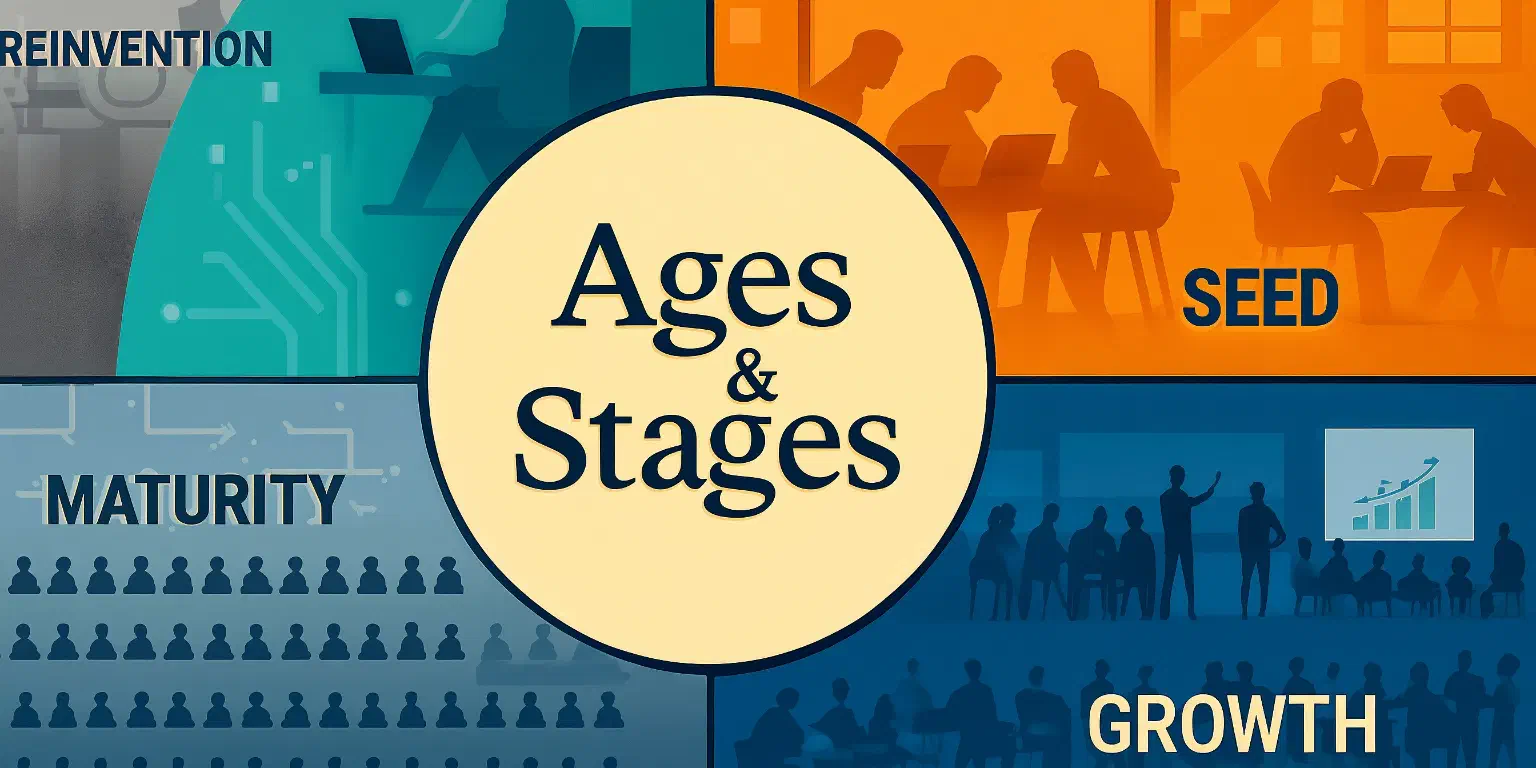
At Wawandco, we’ve pretty much seen it all. We’ve watched tiny 5-person startups try to use the super-complex Scaled Agile Framework (SAFe). They end up drowning in meetings before they write a single line of code! On the flip side, we’ve seen huge 500-person companies try to “move fast and break things” using Trello. Total chaos. Systems crash, and customers get furious.
The lesson here is simple: The way you work (your process and tools) that makes you win at one stage will make you fail at another.
The biggest myth in software is the “one-size-fits-all” methodology. Being truly “agile” isn’t about following a rulebook. It’s about always tweaking how you work to fit where you are right now.
And hey, this isn’t just a gut feeling. It’s a proven business fact. In a classic Harvard Business Review article, a guy named Larry Greiner came up with the “Greiner Curve of Growth.” He showed that as companies get bigger, they go through predictable stages. Each stage of growth ends with a “crisis” that you can only solve by changing things up for the next phase [1].
Your software’s journey is exactly the same. Let’s walk through the four main stages of a product’s life and see how your work, your tools, and your team need to change.
This is the “garage” phase. The air is thick with ideas, coffee, and a little bit of panic. The only thing that matters is answering one question: “Are we building something anyone actually wants?”
Meet the founding team! This is a tiny group of 2-10 people, working out of a “garage” (or just a spare room). Roles? What roles? The CEO is also the tester and customer support. Funding is Bootstrapped, Pre-Seed, or Seed, which really just means you’re watching the “runway”—how many months ’til the cash runs out. The product isn’t a product. It’s just an idea in a mockup, a clickable prototype, or a buggy “Minimum Viable Product” (MVP). The vibe is casual, passionate, a little chaotic, and super high-energy. You talk by tapping someone on the shoulder or sending a quick Slack.
Your goal isn’t to be efficient. It’s to learn, fast. Building the wrong thing is a total disaster. You need to build something, get feedback, and change direction (pivot)—all in the span of a week.
This is what Greiner called “Growth through Creativity.” The trap is getting fancy too soon. Don’t! Don’t install Jira and start demanding 3-week sprints with story points. Don’t build some complicated, automated pipeline. That’s like putting a rocket engine on a skateboard. You’ll spend all your time on the engine and never even learn how to ride!
Congrats! You found something that works. People are signing up on their own. You’ve hit product-market fit. Now, the garage is on fire (in a good way!), and you need to build a real house—fast.
You’ve found your groove, and now it’s a race to grow. The team is ballooning to 15-75+ people. You’re hiring specialists: your first real Product Manager, your first QA engineer, your first DevOps team. Funding is Series A or Series B, and investors now want a predictable “growth engine,” not just a cool dream. Your MVP is now a “Minimum Marketable Product.” The user base is exploding, and your new enemies are downtime, bugs, and slow load times. That “family” feeling is getting strained. The founders can’t be in every meeting anymore. This is what Greiner called the “Crisis of Leadership” and “Crisis of Autonomy” [1]. It’s time to add some structure to the chaos.
Your new goals are repeatability and scale. You have to get multiple teams to work together. You can’t just have developers “ship it” when they feel like it. You need a real plan for what to build (prioritization) and how to build it well (quality).
Holding on to that early “cowboy coding” chaos. If you don’t add structure now, you’ll drown in technical debt, team fights, and constant firefighting. Your whole development process will grind to a halt.
You’re an established player now. Your product is a “cash cow” with a big, stable user base. Your focus isn’t on “finding users” anymore. It’s on “keeping users” and “boosting their lifetime value.” The new danger? Getting lazy.
Meet the market leader. This company is big, with 100 - 1,000+ employees split into proper departments. Funding isn’t about frantic VC rounds; it comes from stable budgets and profits. The product is a super-complex, mission-critical system that your competitors are all trying to copy. Your focus has totally shifted from finding a market to defending it. The biggest risk isn’t “building the wrong thing” anymore. It’s “failing to innovate” and turning into that old, clunky “legacy system” everyone hates. Culturally, “The Process” is king. That gives you stability, but it’s also Greiner’s “Crisis of Red Tape.” Silos pop up, and “how we do things” becomes more important than “why we do them” [1].
Your goals now are efficiency, stability, and small, steady innovations. You have to manage a complex system (think: security, compliance) while also finding ways to experiment (like A/B testing new features).
Letting your process turn to stone. If someone needs a 20-page approval form just to change a button color, you’ve let your “Maturity” process completely kill the “Seed” stage innovation you still desperately need.
Sooner or later, every product gets here. The market changes, a new competitor shows up, or your tech just gets old. The company has to make a tough choice: let the product fade away gracefully, or go all-in on a total reinvention.
This company’s main product is now facing a big shift. It’s become a legacy system. Fewer people are using it, it’s a pain to maintain, and nobody wants to work on it. The team for this old product is often shrunk to a “skeleton crew” to save money, and budgets are slashed to squeeze out the last bits of profit. This can lead to low morale and a lot of uncertainty. The company is at a crossroads: just manage the decline, or… fund a new, independent “skunkworks” team to find the “next big thing” and bring back that high-energy excitement.
This stage breaks into two very different paths:
This is the deadliest trap of all: Forcing your “Reinvention” team to use the “Maturity” process. If you make your new, innovative team get 10 levels of approval, use the enterprise Jira, and stick to a 6-month release schedule… their new idea will be dead before it even starts. You’re asking a speedboat to act like an oil tanker. It just wont’t work.
There’s no “best” process. There’s no “perfect” tool. There’s only the right fit for your product’s stage, your team’s size, your funding, and your market.
The journey from a garage to a global company is all about change. A real partner doesn’t just build your software; they help you navigate this crazy journey. At Wawandco, we’ve been that 3-person ‘Seed’ team moving at lightning speed. And we’ve also been the ‘Maturity’ partner scaling huge, complex systems.
We don’t sell you a one-size-fits-all process. We look at where you are, and then we help you pick, implement, and—most importantly—adapt the practices that actually make sense for you.
Do your processes feel like they’re causing more friction than flow? Are your tools holding you back instead of pushing you forward?
Let’s talk. We can help you get your game plan in sync with your goals, no matter what stage you’re in.